



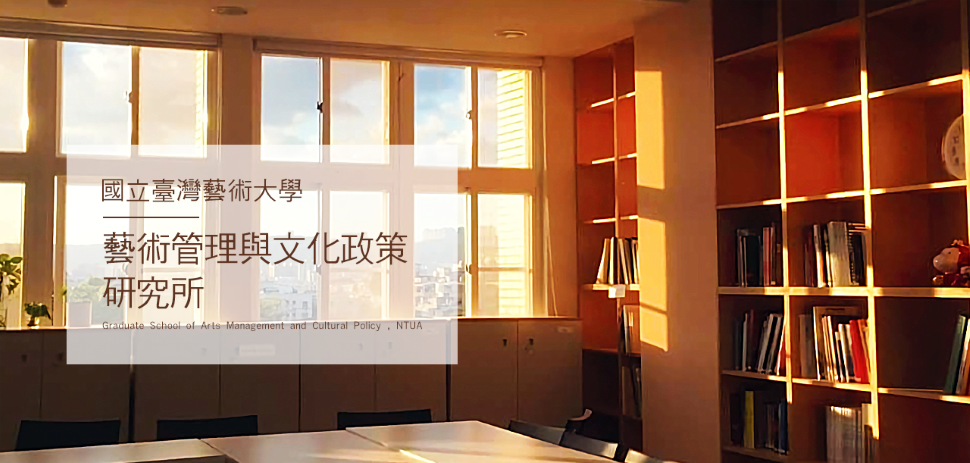
Art and Culture are important indicators which reflect a social spirit and material dimension. However, the profound nature of contemporary art-culture development depends on a visionary cultural policy and effective arts management. A visionary cultural policy is based on the investigation of a time trend, authentication of theory and thought, and analysis of policy and regulations. Arts management is rooted in the recognition of art and history, practical training of marketing management, stimulation of creativity, and design. In order to match the tendency and needs of the national-art culture under the framework of the present and future, including the local and global, the ACPM formulated a program combining the theoretical and the practical. We hope that this program will inspire research students to discover problems, comprehend new phenomenon, start interpretation, utilize rational criticism, and finally formulate profound and sharp opinions. Hence, through these writings a strong foundation of thought and action will be developed. “Arts management” and “cultural policy” are two pivotal points of the ACPM included in the core fields of MA and PhD programs respectively. These two programs are two sides of the same coin which help research students obtain more comprehensive prospects. In conclusion, the Graduate School of Arts Management and Cultural Policy (ACPM) of National Taiwan University of Arts (NTUA) has positioned itself as an educational and research institute emphasizing the power of action and critical subjectivity.
The Graduate School of Arts and Humanities Instruction【Playing in the Arts. Nurturing Stars】Five different colored fish symbolize the convergence of humanities, performance, fine arts, design, and communication. Researchers, guided by morality and benevolence, teach and learn in the arts, immersing themselves in the cultivation of stars. The starlight shines in the eyes of each fish, playing in the arts, an image of the culmination of truth, goodness, and beauty. was officially established in August 2007. The Graduate Institute of Arts and Humanities is based on the professional development characteristics of three major fields: visual (fine arts), auditory (music), and kinesthetic (drama and dance). It integrates the commonalities of different fields and connects with the professional professors of the university's Teacher Training Center to develop the content of integrated arts and humanities courses.

The Teacher Education Center (hereafter referred to as the Center), approved by the Ministry of Education, began offering teacher education programs in the 85th academic year. In the 87th academic year, it was honored with the Ministry of Education's "Outstanding" evaluation for teacher education institutions. In the 88th academic year, the Center was authorized to offer a secondary education program and, in the 90th academic year, established a program for elementary school teacher education. The program encompasses the three major fields of the arts—visual arts, music, and performing arts—providing a 12-year pathway for training art education professionals and offering a comprehensive arts education preparation.
Since its establishment over 20 years ago, the Center has been nurturing teachers for both secondary education and elementary education programs. Aligned with the university's educational philosophy of "Truth, Goodness, Beauty," the Center focuses on "Aesthetic Education" as the core of its teacher training and development. The Center is dedicated to training individuals who view "education" as a lifelong career, possess a deep passion for teaching, and embody the teacher qualities of love, patience, and care. The Center provides professional education and training to these individuals, encouraging their continuous self-improvement and advanced study, helping them become outstanding teachers in their specialized fields of the arts.
Each year, the Center offers two classes for both the secondary education program and the elementary education program, based on the quota set by the Ministry of Education. Starting from the 112th academic year, the elementary school program will also include an option to specialize in the arts. The secondary education program currently trains teachers specializing in 11 areas, including visual arts, music, and performing arts.
In the most recent graduate employment survey, it was found that 51% of the graduates who were tracked and employed in teaching and education-related positions (including full-time and substitute teachers in public and private secondary and elementary schools, as well as administrative roles in various educational institutions and schools) are actively working in the field of education. This high percentage of graduates entering teaching and education-related positions demonstrates the effectiveness and success of the Center’s programs.
A university is a temple of truth, and art is a force that elevates the spirit and inspires growth. If art education is divided into too many specialized areas too early, students may lack knowledge and methods from outside their own field. This narrow focus can limit their perspective, preventing them from understanding the evolution of ideas, societal trends, and the development of modern knowledge. It could potentially narrow or professionalize art education, reducing it to mere "artisan" training.
Therefore, based on the university's founding philosophy, the General Education Center plans to design all general education courses within three major domains: Humanities, Social Sciences, and Natural Sciences. Each of these domains will be further structured into thematic series, with each series containing several semester courses. All general education courses will complement the university's specialized art programs. For art-related courses already offered by various departments, we will minimize their repetition within general education courses, focusing instead on strengthening the areas of Social Sciences and Natural Sciences. In the Humanities domain, we will emphasize key subjects such as literature, philosophy, and history, as they have a stronger connection to art education.
This planning aims to ensure that the university’s education, which is primarily focused on teaching specialization, also promotes a balanced development. Through these courses, students will gain a deeper understanding of the interconnections between themselves (both psychologically and physiologically), their social environment, and the natural world, helping them navigate and live meaningfully in modern society.






 Donate