



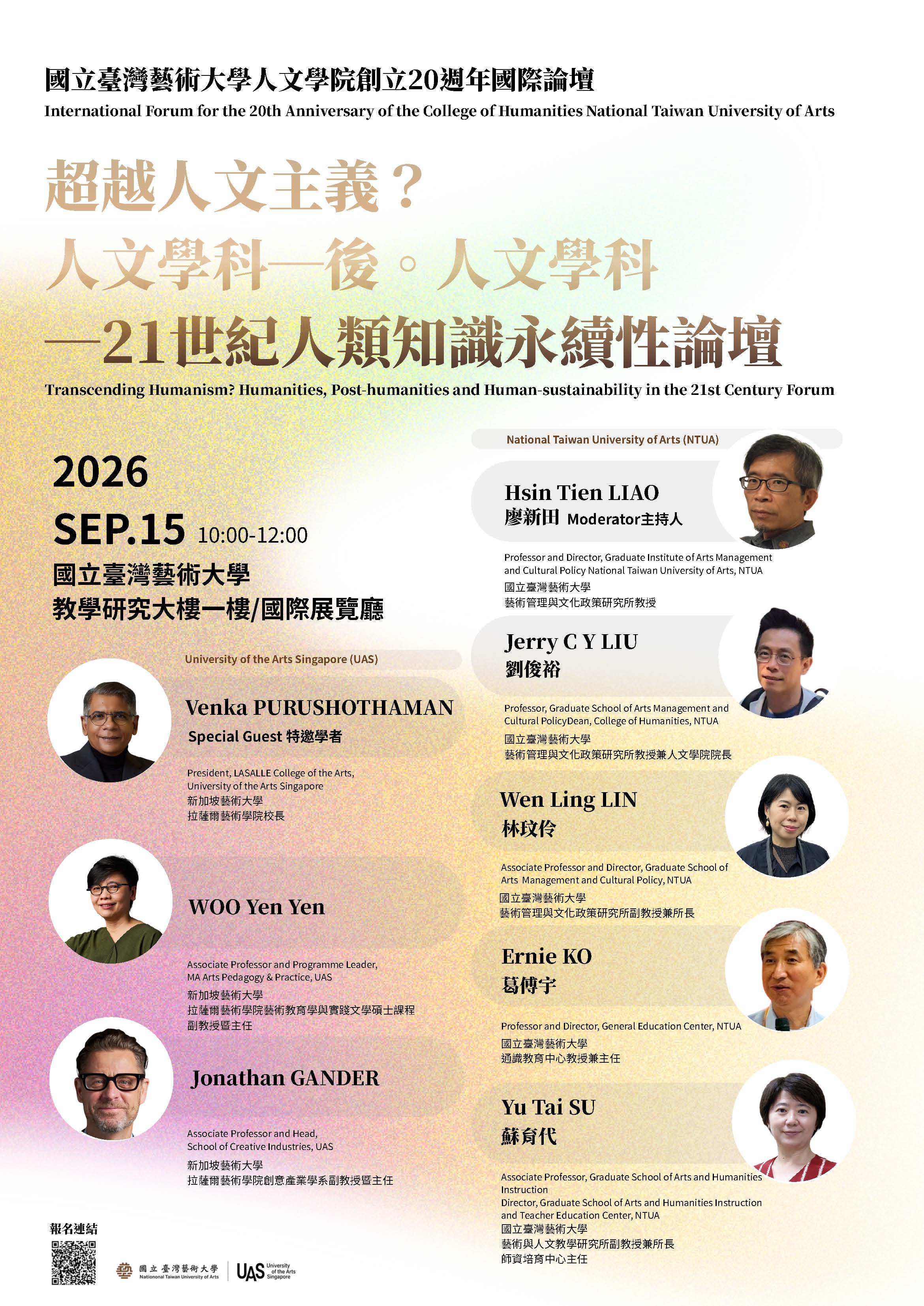
國立臺灣藝術大學人文學院欣逢創立 20 週年,我們非常榮幸與 新加坡藝術大學(University of the Arts Singapore, UAS / LASALLE) 攜手,共同舉辦【超越人文主義?人文學科—後。人文學科—21世紀人類知識永續性論壇】。面對 AI 科技擴張、氣候變遷與全球永續發展的衝擊,人文學科如何走出象牙塔?本論壇邀請到來自臺灣與新加坡的學者專家,共同探討人文學科如何跨界融合自然科學、商管與科技,引領 21 世紀人類知識的永續轉型。誠摯邀請全校師生及各界貴賓踴躍報名參加!
【論壇資訊】
- 論壇主題: 超越人文主義?人文學科—後。人文學科—21世紀人類知識永續性論壇
- 日期: 2026 年 9 月 15 日(星期二)10:00 - 12:15(09:40 開始報到)
- 地點: 國立臺灣藝術大學 國際展覽廳
- 主辦單位: 國立臺灣藝術大學、國立臺灣藝術大學人文學院
- 合作單位: 新加坡藝術大學、拉薩爾藝術學院 (LASALLE | UAS)
【議題與講者】
- 【開幕致詞與特別貴賓】
- 鐘世凱 校長(國立臺灣藝術大學)
- Venka PURUSHOTHAMAN 校長(新加坡藝術大學拉薩爾藝術學院)
- 主持人:廖新田 教授(臺藝大藝政所教授、前人文學院院長)
- 【主題演講與專題座談】
- 劉俊裕 教授兼院長(臺藝大人文學院)| Transcending Humanism? Humanities, Post-humanities and Human-sustainability in the 21st Century
- 林玟伶 副教授兼所長(臺藝大藝政所)| Why Do the Humanities Matter? Reflections from a Cultural Sustainability Impact Assessment Framework for Museums
- Jonathan GANDER 副教授兼主任(新加坡藝術大學拉薩爾藝術學院創意產業學系)| The Triple Hermeneutic in the age of AI: What are the responsibilities of the arts manager?
- 蘇育代 副教授兼所長(臺藝大藝教所)| Beyond the Performance: Human Sustainability through Diverse Support Systems in Taiwan’s School Music Ensembles
- WOO Yen Yen 副教授兼主任(新加坡藝術大學拉薩爾藝術學院藝術教育學與實踐文學碩士課程)| Re-Sensing Culture: Restoring Reflection and Friction in the Age of AI
- 葛傳宇 教授兼主任(臺藝大通識中心)| General Education Reforms and EMI Teaching at NTUA
∗詳細議程及講題請參閱報名連結 https://forms.gle/AoJrt38p6gpbGqru7
期待您的蒞臨與交流!
Transcending Humanism? Humanities, Post-humanities and Human-sustainability in the 21st Century Forum
The international forum “Transcending Humanism? Humanities, Post-humanities and Human-sustainability in the 21st Century,” is convened to mark the 20th anniversary of the College of Humanities at the National Taiwan University of Arts. Framed by a critical interrogation of the epistemological, ethical, aesthetical, and ontological foundations of humanism, the forum seeks to engage directly with the challenges posed by global sustainability agendas and shifting geopolitical realities. It critically examines how contemporary developments in politics, economics, society, ecology, and technology—particularly within Asia—are reshaping the research, teaching, and knowledge domains of the humanities. Through reflection on these transformations, as well as on the humanities’ responses, reconstructions, and reactions, the forum explores pathways toward the sustainability of human knowledge in the 21st century.
For centuries, humanism, grounded in the subjectivity of human beings and the capacities of human reason, has occupied a prominent position in both Eastern and Western intellectual traditions. Through observation, analysis, and critical inquiry, humanistic knowledge has sought to understand human emotions, ethics, and cognition while enabling humanity to comprehend and shape its natural and social environments. However, under conditions of late modernity characterized by disciplinary specialization and the increasing differentiation of knowledge, the influence of humanistic values has gradually declined.
This changing landscape compels scholars and educators in the humanities to confront a fundamental question: How can the humanities continue to justify their social relevance and public value in the face of unprecedented global challenges? Faced with these pressing questions, how can the faculty and students of UAS and NTUA move beyond the traditional confines of the academic ivory tower? How does university-based cultural practice and social engagement generate new forms of knowledge production, learning, and innovation? More fundamentally, how might the humanities and culture reclaim their leadership roles in contemporary society?
Looking toward the future, the forum invites critical reflection from colleagues in NTUA and UAS on how human beings might coexist more equitably and harmoniously with non-human species, ecological systems, artificial intelligence, technological infrastructures, and institutions. At a deeper level, it explores the transition from an anthropocentric worldview toward a more pluralistic and relational post-human condition, one that recognizes diverse forms of agency and interdependence. In doing so, the forum seeks to advance human-sustainability, and the renewal and transformation of humanistic knowledge in an increasingly shifting world.
Registration: https://forms.gle/AoJrt38p6gpbGqru7






 贊助本院
贊助本院